Global VPN market size and share report 2026


The use of VPNs, virtual private networks, is constantly increasing due to surging demand for secure remote work, rising cyberattacks, and political events. Today, over 1.75 billion people are VPN users, fueling a global market that is projected to reach $86.02 billion in 2026.
Below, we’ve compiled the latest statistics on the global VPN market size and share to keep you informed about the VPN industry’s growth and advancements.
- $71.25 billion – 2025 global VPN market value.
- $182 billion – projected VPN market size by 2030.
- 1.75 billion - number of VPN users worldwide.
- North America – VPN market region leader.
- Cisco Systems – company dominating the VPN market share.
- Remote work, cyberattacks, and political events – the main drivers of VPN market growth.
🏷️ LIMITED OFFER: NordVPN deal! Get 78% OFF NordVPN + 3 months FREE 🏷️
VPN market size in 2026
The VPN market is experiencing significant growth as the cybersecurity tool shifts from niche tech to a daily necessity. The VPN market is projected to grow from $71.25 billion in 2025 to $86.02 billion in 2026 at a compound annual growth rate (CAGR) of 20.7%.
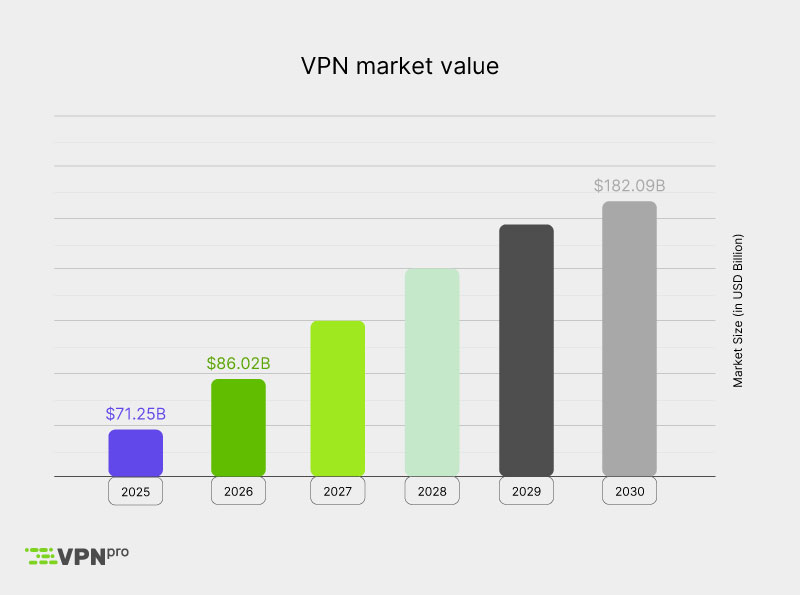
Looking ahead, the growth doesn’t seem to be slowing down any time soon, as by 2030, the VPN market is projected to reach $182.09 billion at a compound annual growth rate (CAGR) of 20.6%. This means that in just 4 years, the market is estimated to double.
How many people use a VPN in 2026?
| People in the world | Internet users | VPN users |
| 8.22 billion | 6.04 billion | 1.75 billion |
While the multi-billion-dollar VPN market value is impressive, the true scale of the industry is easier to grasp when expressed in terms of total users. With over 1.75 billion people using a VPN, roughly one in three people online now secure their browsing using it. On a global scale, that equals approximately one in five people on Earth.
The VPN user number is larger than the number of people who speak Mandarin, the most spoken language in the world. Comparing the numbers this way really shows just how widespread VPN usage has become.
VPN market share by region
North America is currently the biggest player in the global VPN market, accounting for 38% of its share in 2025. It is leading the industry thanks to its advanced cybersecurity infrastructure, high enterprise adoption in BFSI and telecom, and the presence of established providers like ExpressVPN and NordVPN. Additionally, North America has a massive demand for secure work-from-home connections and data privacy regulations, which further accelerate its VPN market growth.
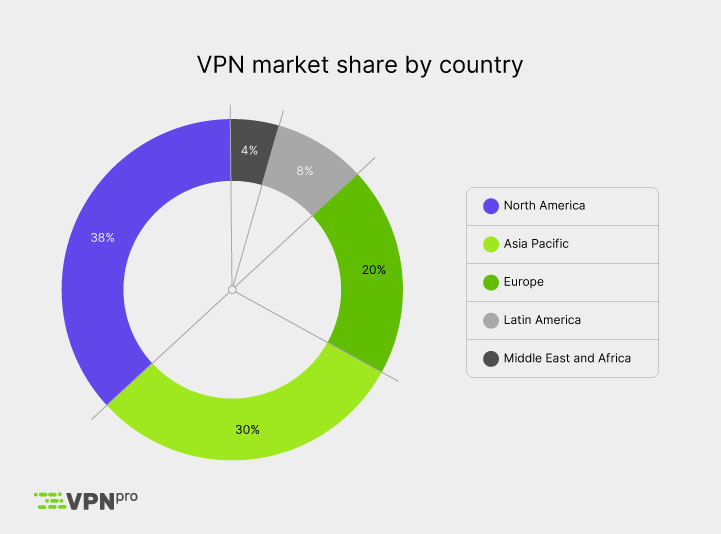
The second biggest player in the global VPN market is Asia Pacific, making up 30% of the VPN market in 2025. Its growth is fueled by rapid digitalization, censorship in big countries like China, and affordable mobile VPN prices amidst 2.8 billion internet users. The region is transitioning to a digital-first economy, with VPNs becoming essential to bypass geo-restrictions, protect personal data, and support hybrid work.
Europe follows closely behind with 20% of the VPN market share in 2025. This is largely due to strict privacy laws, like GDPR, that push companies to use high-level encryption to protect data. With many businesses operating across different countries, they rely on VPNs to keep their remote work secure. Additionally, Europe’s advanced tech setup uses VPNs as a basic tool to stop cyberattacks and follow government rules while moving data safely between borders.
Meanwhile, Latin America holds an 8% market share, led by a digital boom in Brazil and Mexico, where remote workers, banks, and online shops are increasingly using VPNs to protect customer data.
Lastly, the Middle East and Africa region accounts for 4% of the market, largely driven by the need to secure high-tech oil and gas operations and remote drilling sites. In countries like the UAE and South Africa, frequent data breaches and new financial hubs have made secure, encrypted connections a top priority for businesses. Across these regions, the rise of 5G and mobile internet is also growing the VPN market.
VPN market share by component
The VPN market is split into two main product categories (i.e., components) that people purchase – solutions and services. The solution is the technology (apps, routers, firewalls, etc.) that users buy to obtain secure connections. It currently takes up the biggest part of the market, with its share being 66% in 2024.
The remainder of the VPN market consists of services that provide professional help necessary to maintain the VPN technology. This may consist of initial setup, consulting on various questions, troubleshooting, or running the tech 24/7. The service category is growing the fastest, as companies are increasingly transferring technological management to companies that offer technical support.
VPN market share by type
The VPN market can also be segmented by connectivity type into three primary categories: remote access, site-to-site, and extranet. Currently, the leader is the remote access category, with a market share of 35%. Its goal is to connect a user (i.e., an employee at home) to a private network (i.e., their office server), which is very useful amidst hybrid and remote work becoming increasingly popular.
Runner-up is a site-to-site connection, which is used by big businesses looking to connect two networks together, such as a branch office in London to a headquarters in New York.
Lastly, the extranet is the smallest but fastest-growing VPN market segment. As companies are opening their internal web applications to their partners and clients, the extranet helps to collaborate without compromising security, and as a result, is growing in popularity.
VPN market share by end-use
When it comes to end-use, the VPN market is split into two main categories: individual and commercial. The end-use segment identifies who is buying the technology. Currently, the commercial end-use dominates the VPN market, making up 77%. VPNs are widely adopted across sectors like BFSI, IT & telecom, retail, and manufacturing as businesses are seeking secure data exchange, remote access, and compliance with global privacy regulations.
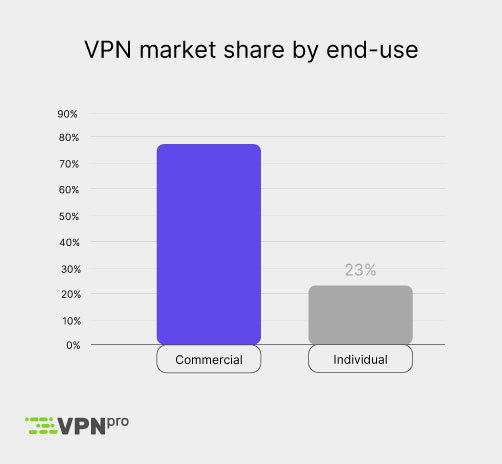
While individual use of VPNs has been growing and has even outpaced commercial use growth, it still makes up a smaller part of the VPN market. Now over 1.75 billion people use VPNs to enhance privacy on public Wi-Fi, streaming unblocking, and torrenting amid data breaches, which impact 300 million users annually.
VPN market share by deployment mode
Deployment mode refers to the physical location where the VPN software is hosted and managed. This can be done on your own purchased servers, i.e., on-premise, or by renting out a space on someone else’s, which is called a cloud-based deployment mode.
In 2024, the cloud segment had the biggest VPN market share of 75%. This is due to the businesses’ tendency to cut expenses and maintenance. By decreasing expenses and maintenance, organizations can concentrate on other essential business objectives.
VPN market share by company
Cisco Systems dominates the VPN market share, accounting for roughly 18%. It has a long history with VPNs offering managed VPN services that are highly favored by organizations for comprehensive protection. While cybersecurity is a major part of their operations, it offers diverse technology, including networking, IT infrastructure, and collaboration tools.
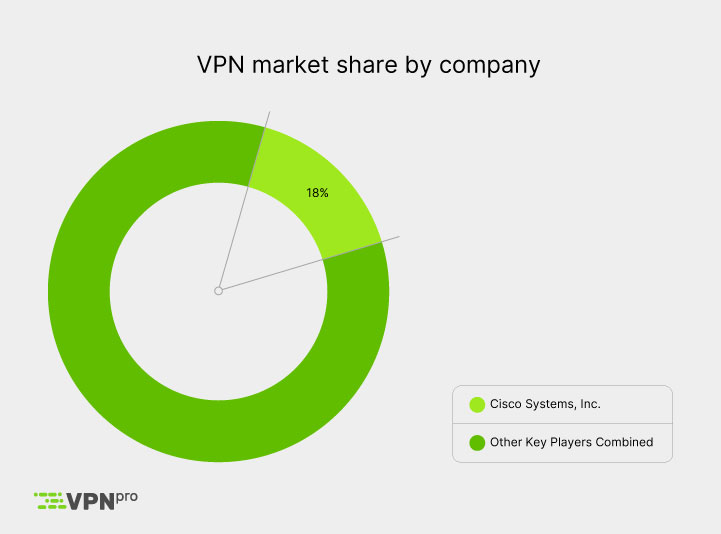
Other VPN market leaders include Palo Alto Networks, Check Point Software Technologies, Fortinet, and NordVPN, providing businesses and everyday users with a wide range of cybersecurity tools and services. They stay ahead by using AI to detect hackers, "zero-trust" security and privacy features like "no-log" policies that promise complete data privacy.
The competition between these companies fuels mergers and partnerships with cloud giants like Amazon and Microsoft to improve their global reach. The competition is also driving the entire industry to create faster, more secure encryption to support the world’s growing need for cybersecurity.
🔗See how NordVPN protects your data
What drives VPN market growth?
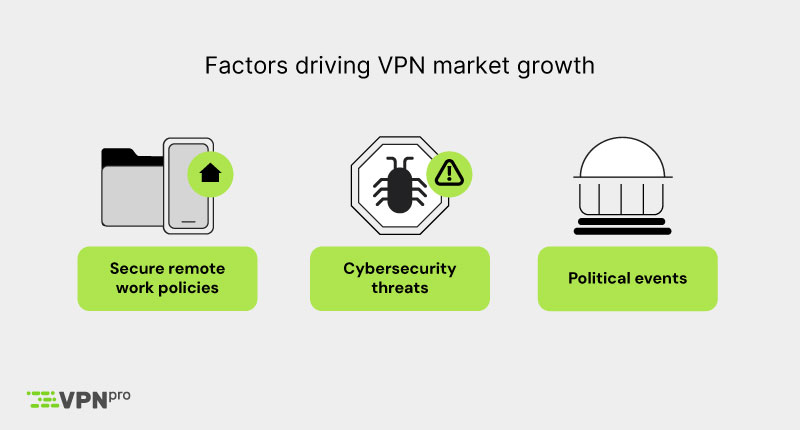
The growth of the VPN market can be attributed to several important factors, from the rapid adoption of secure remote work practices to political events. Here’s a better look at the main forces that currently drive VPN market growth:
- Adoption of secure remote work practices. In 2024, 7 out of 10 organizations in a global survey mentioned access for remote employees as the main reason for their VPN use. VPNs are critical for remote work because they protect the company’s sensitive information from cyberattacks and leaks. They also enable access to internal tools and systems, ensuring employees can work from any location.
- Rising cybersecurity threats. It’s a modern issue that continues to grow, especially with the help of AI-powered tools that make hacking faster and more accessible. In 2024, encrypted threats increased by 92%, while phishing attacks increased by a whopping 1,265%.
- Political events. It was noticed that VPN usage spikes during times of political unrest. Most recently, as a result of mass protests in Iran, residents experienced internet restrictions, which made VPN demand jump by 579% in late January, 2026. The global wave of Online Safety Acts has also recently increased the use of VPNs, as residents become concerned about their data privacy amidst age verification laws. Proton VPN alone reported an 1,800% increase in downloads of its VPN app after Australia implemented mandatory age checks on social media platforms, search engines, and adult sites.
All of these factors and more increase the demand for VPNs and online and data privacy. Amidst remote work, increasing cyberattacks, and political unrest, a VPN has become a necessity that more and more people are adopting in their daily lives.


Since 2018, VPNpro has delivered unbiased, expert-backed insights through in-house research and thorough VPN testing. Our team ensures every review is fact-checked and reliable. Learn how we maintain these high standards in our testing methods.
Sources and methodology
To compile this report, we used the newest information from 2024 to 2026. Figures in the article come from various global VPN market reports, all transparently referenced throughout it.
Conclusion: Overview and looking ahead
This data shows the increasing demand for privacy and data protection that VPNs offer both on a commercial and individual level. Meanwhile, the VPN market share distribution in various segments reflects the industry’s tendencies and what can be expected from VPNs in the future.
As the VPN market moves toward reaching the projected value of $182 billion, companies will continue to improve their performance with a focus on remote work and cloud-based services. Many businesses and individuals already protect their data and online activities with VPNs, and that number is only projected to grow.

![Surfshark weekly deals logo [IN USE]](https://media.vpnpro.com/surfshark-weekly-deals.svg)
![Proton VPN winner logo [IN USE]](https://media.vpnpro.com/2025/05/protonvpn-winner.png)
FAQ
How big is the VPN market?
The VPN market was valued at $71.25 billion in 2025 and is projected to increase to $86.02 billion in 2026.
What is the biggest VPN market region?
The biggest VPN market region is North America, which accounts for approximately 38% of the global market share in 2025.
What are the key players in the VPN market?
The biggest company in the VPN market is Cisco Systems, which makes up roughly 18% of the entire VPN market. It’s followed by Palo Alto Networks, Check Point Software Technologies, Fortinet, and NordVPN, all of which provide businesses and everyday users with a wide range of cybersecurity tools and services.
What drives VPN market growth?
VPN market growth is mostly fueled by remote work policies, cyberattacks, times of political unrest, and government restrictions. These factors raise the demand for safe access to the internet and data.



- VPN market size in 2026
- How many people use a VPN in 2026?
- VPN market share by region
- VPN market share by component
- VPN market share by type
- VPN market share by end-use
- VPN market share by deployment mode
- VPN market share by company
- What drives VPN market growth?
- Sources and methodology
- Conclusion: Overview and looking ahead
- FAQ